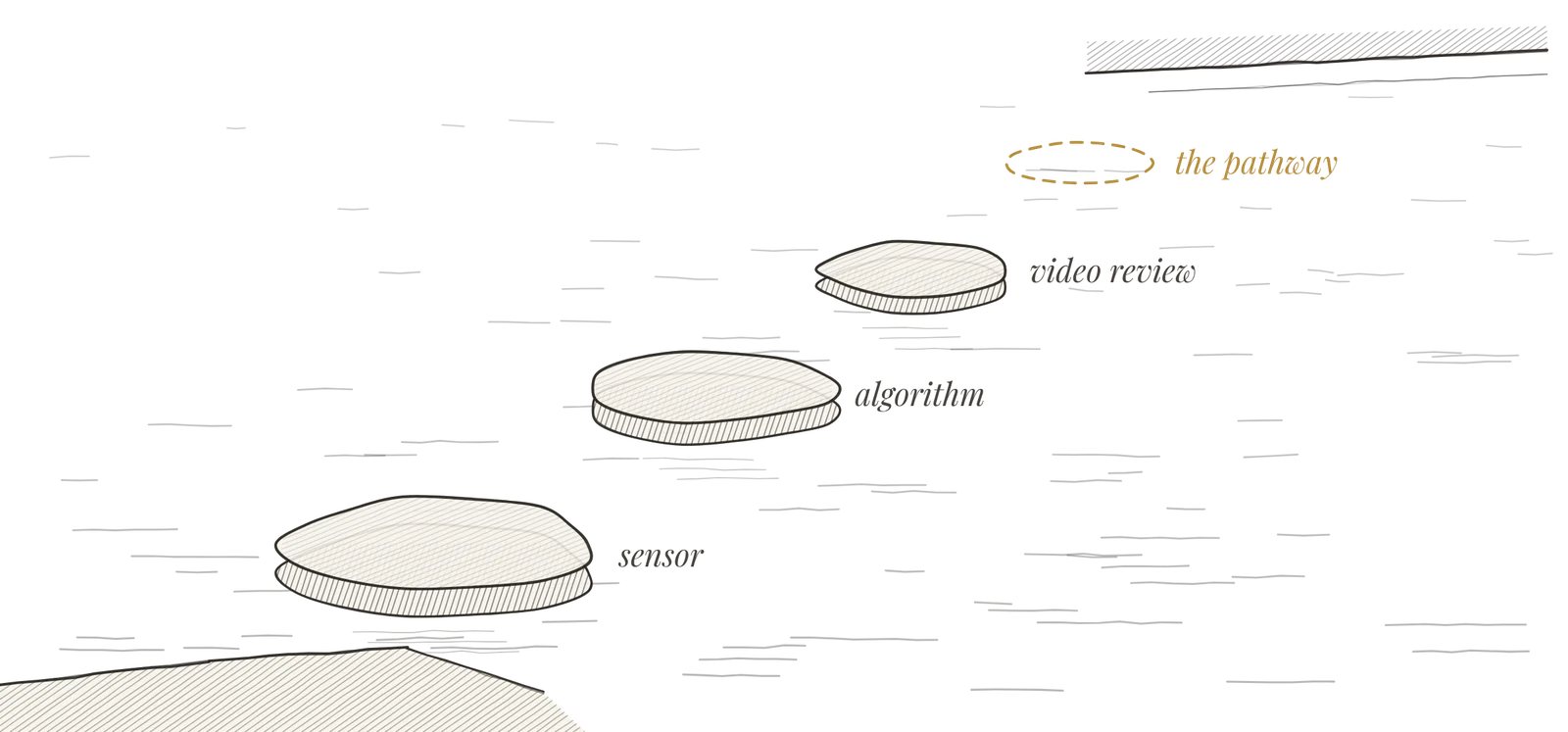
Each issue we pick one under-studied corner of HIE care and ask about it plainly, without pretending an answer already exists. This issue’s spotlight comes straight from the book’s index case: a father who spends six months watching his daughter sleep, looking for signs of an “invisible storm” he has no way to read.
The question, stated precisely
After NICU discharge for high-risk infants, is there a safe, practical, non-invasive, clinically validated way to capture abnormal electrographic brain activity in the home when caregivers observe concerning movements?
Put that way, the question doesn’t allow a quick yes. Each word sets its own bar. Safe means no skin injury, no risk of entanglement or unsafe sleep, and no extra medication burden. Practical means a trained caregiver can start it within minutes without a technologist there. Non-invasive means it sits on the scalp or doesn’t touch the baby at all, with no needles or implanted sensors. Clinically validated means its signal quality and seizure detection have been compared against standard video-EEG in infants, with sensitivity, specificity, and false-alarm rates reported. A rapid scoping review of current PubMed-indexed literature, ILAE position papers, trial registries, and device regulatory information found no peer-reviewed study that met all four for this population as of September 2026.
Why this isn’t a hardware problem
Reduced-electrode neonatal EEG devices, automated seizure-detection algorithms, and AI video models are already out there. Each has been validated to some extent, and each is limited to the hospital or to older children. What hasn’t been built or tested is the system around them: which caregiver puts a device on and how they’re trained; how a flagged signal gets to a clinician and how fast; what the family is told while they wait; and what happens after a false alarm or a missed event. That pathway, not a smaller electrode or a faster chip, is the gap this spotlight is about.
Why it matters beyond one family
The book describes one father’s six months of unbroken night-time watching, and a second episode where the worrying event happened in the few minutes he had stepped out. Read as testimony, not as a medical record, it shows a kind of caregiver burden that published research on post-discharge HIE care rarely measures directly: how often families see things they can’t interpret, what they do next, and what it costs them to keep watching with no proven way of knowing whether watching is even the right response.
What a study could ask
- How often do caregivers of high-risk infants see movements that worry them after discharge, and what do they do next?
- When properly recorded, what share of the events caregivers flag actually show up on EEG?
- Can caregivers reliably put on and start a recording device, and is the signal good enough to read?
- Does having a validated way to capture events change caregivers’ anxiety, sleep, or use of health care, for better or worse?
Research Gaps Spotlight note: drawn from Sections 3.3–4.5 of “From Lived Experience to Research Questions” (A T M Haidar Khan, 2026, DOI 10.5281/zenodo.22927886). The prospectus treats the memoir strictly as a source of research questions, never as clinical evidence, and makes no claim about what any specific event in the book was medically.